
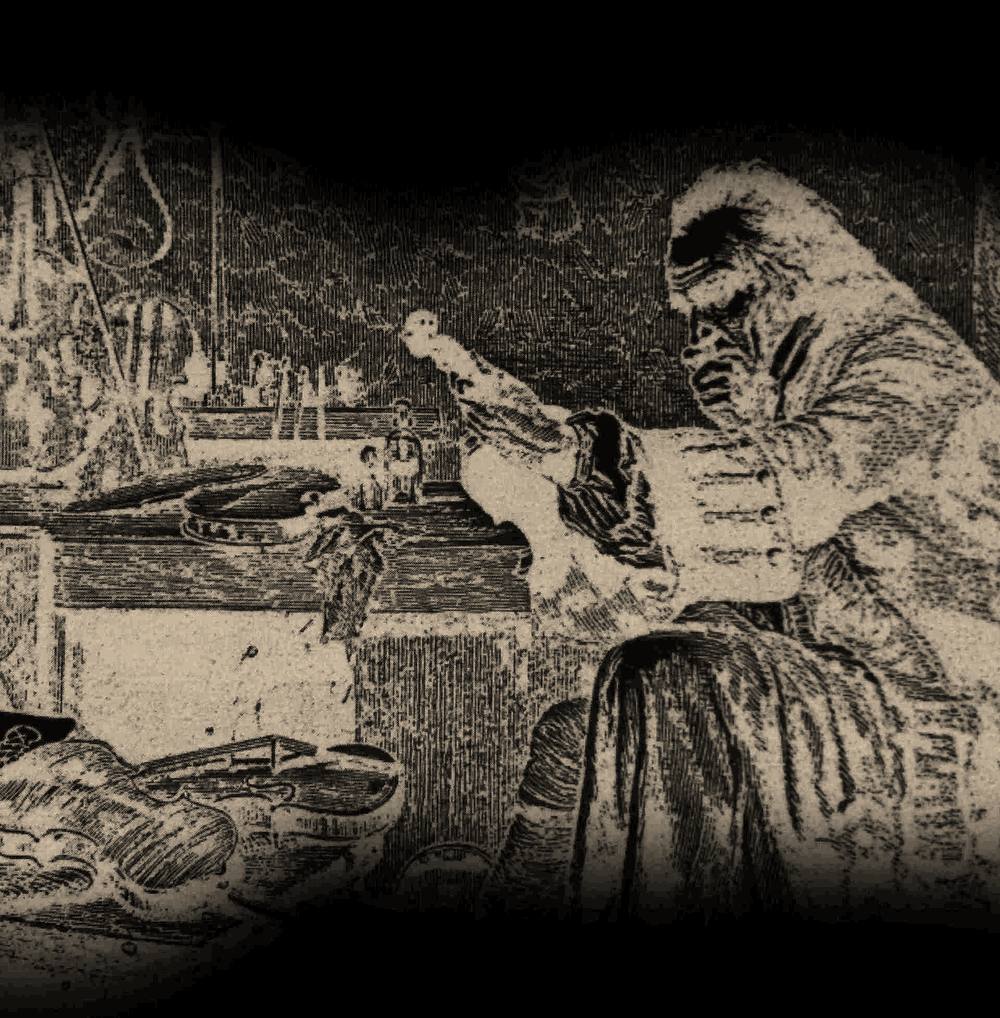
How the Circle began
The founding of the Circle of Czech Master Violinmakers is tied to the inglorious era after February 1948, when the Communists seized power in Czechoslovakia. Gottwald’s first government promised to preserve at least the small tradespeople, but the promises came to nothing. Nothing good could be expected from a dictatorship that imitated the ruthless and primitive dictatorship of Bolshevik Soviet Russia, begun by V. I. Lenin in 1917 and brought to the height of terror under J. V. Stalin. Under the convenient slogan of nationalisation, the liquidation of private property for the utopian benefit of “all the people” soon became reality in our country as well. Violin-making workshops and shops were threatened with nationalisation too. It was then that a saving idea was born: what if violin making were recognised as an art, and therefore a free profession, rather than a craft subject to the trade laws? What if violin makers tried to obtain the status of a “free profession”? Then hand-made violin making would not be subject to nationalisation…
The initiator of this attempt to save independent violin making was Otakar Špidlen (1896–1958), at the time a successful violin maker and dealer. At the beginning of 1950 he wrote a kind of manifesto in defence of violin making, entitled THE DEFENCE OF VIOLIN MAKING AS AN ART, with the subtitle IS VIOLIN MAKING AN ART OR A MERE CRAFT? It was signed by many distinguished figures, not only from among musical authorities; their names, and the renowned institutions to which many of them belonged, are listed below.
The addressee – the Ministry of Education, Science and Arts headed by Zdeněk Nejedlý, appointed after the “Victorious February” – eventually and condescendingly recognised hand-made violin making as one of the categories of the free arts. The status of a free profession, however, required membership of an artistic organisation. And so, also at the initiative of professional string players united in the Section of Concert Artists of the Union of Czechoslovak Composers (the predecessor of AHUV), the Circle of Czech Master Violinmakers was founded as a shield and the only space for the relatively free work of Czech violin makers. Its founding members included Přemysl Špidlen, Karel Vávra and others. Otakar Špidlen himself, who died in May 1958, did not live to see the Circle established on 2 July of the same year.
Under the wings of the Circle, many Czech violin makers thus survived the dictates of Communism. After the revolution of 1989 and in the new political circumstances, new questions arose: is KUH still necessary? Should it be changed somehow? Or should a new Circle be founded? There were some very heated discussions. In the end the members agreed that it would be a pity to dissolve the Circle with its tradition and good name, and that it is in fact still needed – above all as a guarantee of quality, especially since no licence is required by law to work as a violin maker or as a restorer of rare string instruments, and practically anyone who has completed an apprenticeship may do so. And finally, to this day it is possible, as a member of an artistic organisation, to work under copyright law rather than solely as a tradesperson, which many members take advantage of.
Today, therefore, KUH insists more than ever on a high professional and artistic standard. Membership is subject to a rigorous assessment of the applicant’s work and expertise, and by no means every applicant is admitted. We are aware that the greatest asset of our Circle is its good name, its high professional and artistic standard, and its prestige – which take a very long time and much effort to build.
The Defence of Violin Making as an Art
Is violin making an art or a mere craft?
English translation of the manifesto of February 1950. The Czech original is on the Czech version of this page.
By way of introduction, let us begin with an extract from the records of the guild of musical instrument makers dated 3 January 1890:
The awareness of musical instrument makers that they belong to the common family of artists was so vivid and deeply rooted, and the tradition of cooperation between instrument makers and performing musicians so strong, that it was not shaken even by the regulation imposed by the trade code – as is best seen in the introductory entry by the late chairman of the guild of musical instrument makers, Jaroslav Dvořák, who on 3 January 1890, outlining in the briefest terms the guild’s first five years, wrote:
It has been acknowledged since ancient times that the making of musical instruments ought to be regarded as an art, and not – as under the decision of the Imperial and Royal Governor’s Office, or rather the Ministry, and the wording of the trade code of 1883 – that only craft trades are obliged to form guilds. As stated above, we do not regard our field as a craft but as an art; nevertheless we agreed to establish the guild, anticipating the success of the whole, but we reserved for ourselves that, should the establishment of the guild not achieve the aim set out above, we would seek by all lawful means to have our field classified among the arts.
The fact that the classical musical instruments – the violin, viola, cello and double bass – can be manufactured in factories leads to the mistaken belief that their creation has nothing to do with art. But just as there is an essential difference between kitsch and the work of a painter or sculptor, or between a village fiddler and a virtuoso, there is a similar difference between an instrument made with love in a violin maker’s workshop and one produced in a factory. Like every other art, the making of a musical instrument is bound by certain aesthetic laws, as is the building of a cathedral or the creation of a painting, a sculpture, or a literary or musical work. And as a work of art, every such instrument bears the character of its maker or school. An expert will therefore hardly be mistaken and will recognise almost at first glance whether an instrument comes from the hand of Amati, Stradivari or Guarneri, or is the work of a Czech, French, German or other master.
Violin making faces demands similar to those of sculpture or painting and, truth be told, draws on both. It must attend to the noble lines and proportions of the instrument as well as to its beautiful colour and choice materials. The personality of the artist is revealed in the elegant line and modelling of the instrument: just as in the instruments of the classical Italian masters we see the temperament, singing ease and softness of the Italian character, so instruments made at the same time north of the Alps bear the marks of austerity, almost the hardness, of the Germanic nature.
Hand in hand with the building of the instrument goes the careful selection of wood and the whole scale of varnish colours, which together form a harmonious whole – a work of art. The artist violin maker must, with uncommon taste and feeling, bring out the figure of the wood, every mirror on the spruce top, every flame and growth ring in its natural beauty.
Time has no ill effect on an artistic instrument made in this way; on the contrary, with time and use (given proper care) it acquires a patina that only increases its beauty and value.
From all this it is clear that the aim of every good violin maker is to make an instrument perfect in form, beautiful in its wood as well as in its transparent colour and varnish. All these are qualities concerning the visual side of the instrument.
No less important, however, is the question of sound, which matters above all to the artist who plays the instrument. It must be borne in mind that just as instruments differ from one another in construction and colour, they also differ in sound – not only in timbre, the colour of the tone (silvery bright, soprano, heroic, tenor, lyrical and elegiac, or dramatically dark), but also in its quality. Besides the artistic problem, the violin maker therefore faces the task of giving the violin a carrying tone and a sufficient reserve of sound, so that it inspires the violinist to ever greater achievement.
The Italian masters succeeded in uniting the beauty of the instrument with the beauty of its sound. They built their instruments so ingeniously that they turned the violin into a truly miraculous acoustic box, harmonising it entirely by ear. That is why an instrument from an Italian workshop is the desire of every musician. These instruments are usually distinguished by the remarkable ease with which the tone is produced and carries, and by the purity of their sound. They allow the artist to shade from the softest pianissimo to the strongest fortissimo. Sometimes other old instruments, or well-built new ones, seem to the listener to equal or even surpass Stradivaris or Guarneris in sound. But only the performer could say how much more effort it takes to draw the tone from them. That is why the perfect instruments of Amati, Stradivari and Guarneri have been tested countless times, carefully taken apart, studied in detail and measured. The knowledge gained has been a valuable guide for modern violin makers. They learned how the wood was prepared before it reached the Italian workshops. One of the secrets of a pure sound is seasoned, well-leached wood. Its cells must be rid of undesirable substances such as resin, proteins and sugars. With age these substances dry into a microscopic powder whose particles vibrate when the instrument sounds, resonating along and producing a rustle, the so-called “sand”, and making the instrument respond less readily. In Italy these substances were removed from the wood in the most natural way – by floating. It was found that trees 150 to 300 years old, felled in the Alpine valley of Val Sugana, were floated down the river Po to Brescia or Cremona, a journey that could take as long as two years. The leaching of these substances was also helped by the quality of the water, which springs from Alpine limestone formations and contains a great deal of alkaline lime. Today, of course, violin makers – Italian ones included – must replace this natural process with an artificial one.
In conclusion, we may say that Czech violin making, and the Prague school in particular, has a glorious tradition and holds a place of honour in history. The names of eminent masters such as Strnad, Homolka (called the Prague Stradivari), Kulík, the distinguished Dvořák family and others are the pride of our art of violin making. Nor are present-day makers idle. In 1949 they entered the International Competition and Exhibition in The Hague, organised by the Municipal Museum’s department “Service of the Fine Arts”, where they took leading places and were awarded four diplomas of honour, surpassing other countries of high cultural standing.
The Krkonoše school, too, became famous for a number of outstanding names – mostly Czechs from the foothills of the Giant Mountains who made their mark beyond the borders of their homeland. Among them were, for example, Vedral, the finest violin maker in Holland; Antonín Pilař, a violin maker in Berlin; František Špidlen, violin maker to the Imperial Conservatory in Moscow; and his pupil Eugen Vitáček, who lived in the USSR until his death. Vitáček earned such great esteem in the Soviet Union that he was entrusted with the care of the State Collection of Instruments, the finest in the world.
In 1924 he was named Honoured Master of the Republic, and later, during the war, Honoured Worker of the Arts, an honour that came with the Stalin State Prize of 100,000 roubles. This shows that in the USSR violin making is valued as an art.
It will surely be our endeavour to excel still further among other nations less musically gifted than our own, and to raise the art of violin making to the standard of our time by seeking the founding of a scientific institute and professional training for young violin makers at a violin-making school, which could be attached to the conservatory, since the two are closely connected – as is the case in the Soviet Union.
Thus we may say without boasting that our art of violin making continues an old and glorious tradition, and it is to be wished that it might at last receive the recognition, understanding and support which, according to the record of 1890 quoted at the outset, it has not received in the past.
Prague, February 1950
Signatories
Karel Vávra – violin maker, Alfons Vávra – violin maker, Otakar Špidlen – violin maker, Přemysl Špidlen – violin maker, Alois Bittner – violin maker, Julius Hubička – violin maker, Jaroslav Hejzlar, Josef Urban, Jos. Boh. Herclík – violin maker, Ladislav Herclík – violin maker, J. Kozák, Alexander Plocek – professor at the Academy of Performing Arts and violin virtuoso, Spytihněv Šorm – violin virtuoso, F. X. Drozen – violin maker, A. Galla – violin maker, J. Pötzl – violin maker, V. Kostečka – violinist, R. Lojda – cellist, František Bílek – sculptor, L. Zelenka – cellist and member of the Czech Quartet, Ludvík Kuba – painter, Vincenc Beneš – painter, Jaroslav Pokorný, Ladislav Vycpálek – composer, N. V. Holzknecht – music theorist, Jaroslav Řídký – composer, Jaroslav Krombholc – conductor, Jiří Reinberger – organist, Max Švabinský – painter, Břetislav Benda, Josef Lada – painter, Karol Plicka – photographer, Ján Cikker – composer, Václav Rabas – painter, Zdeněk Wirth, Karel Šejna – conductor, A. M. Brousil – professor at the Academy of Performing Arts, Bedřich Nikodem – composer, Břetislav Novotný – violinist and member of the Prague Quartet, Karel Šrom, Jaroslav Doubrava, Vojtěch Frait – concertmaster of the Czech Philharmonic, Bedřich Černý, Jiří Bezděkovský, Jaroslav Vojta – actor, Karel Pravoslav Sádlo – cellist, Václav Sádlo – cellist, Miloš Sádlo – cellist, Ivan Kawaciuk – violinist, František Zyka – violin maker, Jan Podešva – violin maker, Konrád Krč – violin maker…
Society of Musical Instrument Makers and Piano Tuners for Bohemia, Artistic Administration of the National Theatre Opera in Prague, National Cultural Commission in Prague, Academy of Fine Arts in Prague, Bedřich Smetana Museum in Prague, Music Department of the National Museum in Prague, Academy of Performing Arts in Prague, Czech Philharmonic, State Orchestra in Prague, Czechoslovak Radio in Prague, Czechoslovak Radio Symphony Orchestra in Prague, Umělecká beseda in Prague, Czechoslovak State Film, Film Symphony Orchestra Prague, Museum of Decorative Arts in Prague, Janáček Academy of Performing Arts in Brno, Prague Quartet, Ondříček Quartet, Czech Trio, Janáček Quartet, Moravian Quartet, Richard Zika Quartet, Slovak Quartet, Slovak Philharmonic in Bratislava, State Conservatory in Bratislava, Academy of Performing Arts in Bratislava…